
The next Analytics revolution isn't about dashboards

Business Intelligence is entering a new era. Dashboards aren't going away, but the way we design, develop and use them is already changing. And so is the role of the Data Analyst.
Between excitement and skepticism, where is BI really heading?
Since the announcement of Claude Dashboards and Claude Motion, a wave of excitement, but also hesitation, has swept through the broader data community.
As often happens with new technologies, different groups are emerging.
On one side, there are those eager to ride the wave, embracing these developments and seeing AI as an incredible opportunity for the industry. The possibilities seem endless, and some of the demonstrations are genuinely impressive.
On the other side, there are the skeptics. Those who remind us that dashboards were supposedly dead a few years ago, only to watch AI companies now generate dashboards themselves.
So perhaps dashboards weren't quite as dead as everyone thought?
Personally, I've always tried to maintain a balanced perspective, and that perspective is becoming even more nuanced as AI continues to reshape data and analytics.
I don't believe dashboards are going to disappear. However, I'm convinced we've entered a profound transformation in how organizations design, develop, distribute, and consume analytics products.
And this transformation will directly affect data professionals and their roles.
What I'm already seeing inside large organizations
Over the past few months, I've had the opportunity to attend several demonstrations within internal data communities at my clients' organizations.
I've seen agentic tools accomplish some remarkable things, attended presentations of new analytics products, and spoken with teams actively involved in this transformation.
More importantly, I've witnessed changes that go well beyond the latest technology hype.
In some large retail organizations, I've seen initiatives aimed at reducing the existing dashboard portfolio by nearly 80%.
In one of these organizations, the target for future analytics products is particularly revealing: only 5 to 15% traditional BI dashboards, with approximately 80% of future experiences expected to rely on AI agents and conversational interactions.
These figures reflect ambitions I've observed in specific organizations, not a prediction for the entire industry. But they illustrate the direction some particularly advanced companies are taking.
I've also attended demonstrations of solutions such as Databricks Genie and its conversational capabilities, along with the possibilities offered by Databricks Apps to develop interfaces using Streamlit, React, and other frameworks.
What strikes me is that we're no longer simply talking about building dashboards faster. We're talking about rethinking the analytics experience.
And that brings a structural change in who owns the design and development of analytics products.
Will Data Analysts still own the front end?
This is probably one of the most significant changes I anticipate.
I believe Data Analysts will gradually become less involved in designing and developing analytics interfaces. Some of these responsibilities may shift toward Product Managers, digital teams, UX Designers, and Software Engineers.
I see both opportunities and risks in this evolution.
By involving digital and product teams more closely in the design process, dashboards and other analytics experiences could become much more connected to users' everyday tasks and business processes.
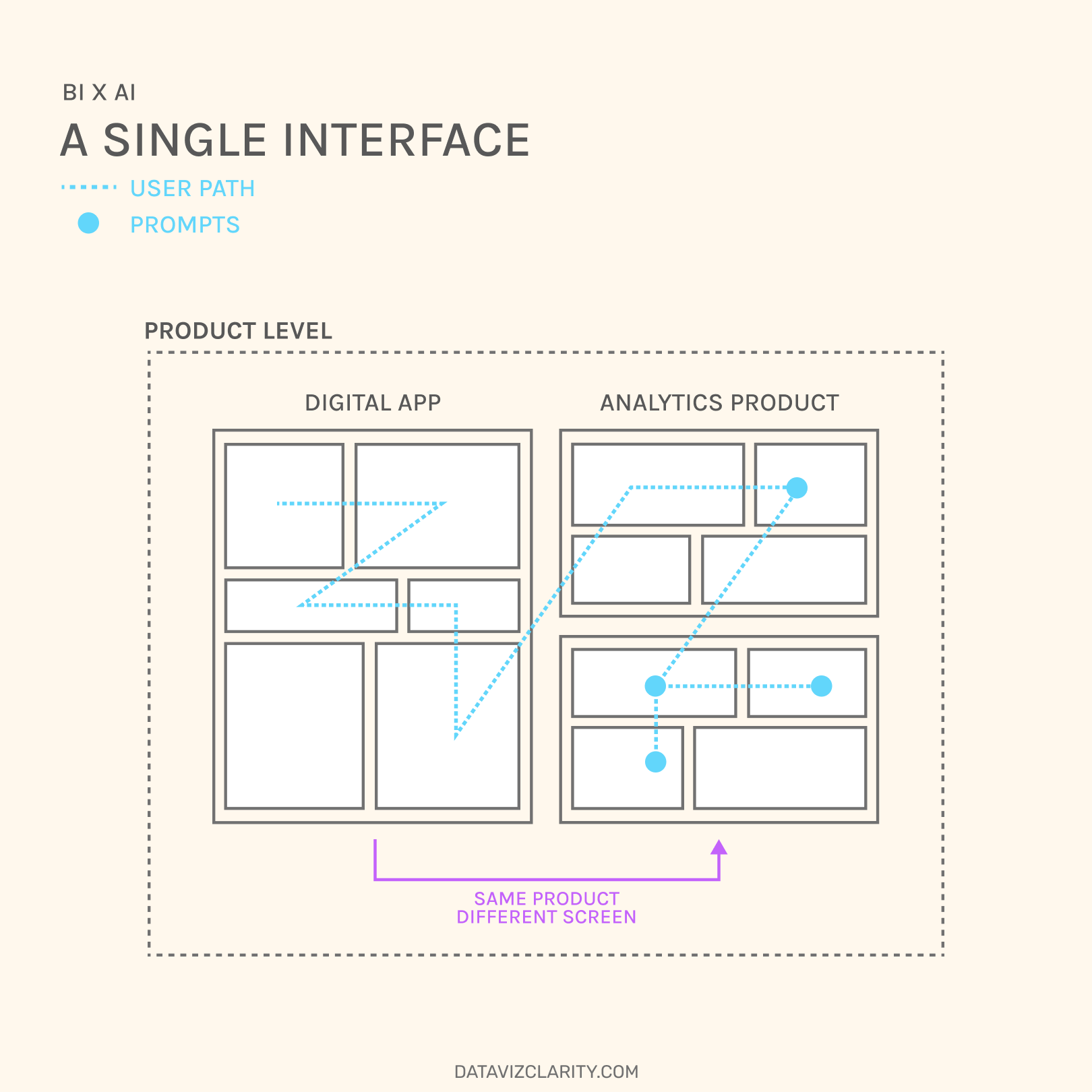
Today, in many organizations, BI still operates as a relatively separate environment.
Users perform their activities in a business application, open a Tableau or Power BI dashboard to check information, and then return to their original application to take action.
With analytics and conversational capabilities embedded directly into business applications, this separation could gradually disappear.
Users could analyze results, visualize metrics, ask an AI agent questions, and receive recommendations in the same environment where they already work.
I believe the potential reduction in Time to Insight is considerable. Information and analytical capabilities become directly available within the workflow, rather than requiring users to switch between disconnected tools.
Of course, we still need to demonstrate that this integration actually reduces the time required to understand a situation and make a decision. But from a user experience perspective, I find this evolution particularly interesting.
Faster development, but the same old mistakes
The second major benefit I'm seeing concerns development.
With frameworks such as Streamlit, Gradio, and React becoming increasingly accessible and AI-assisted development capabilities advancing rapidly, building analytics interfaces is getting significantly faster.
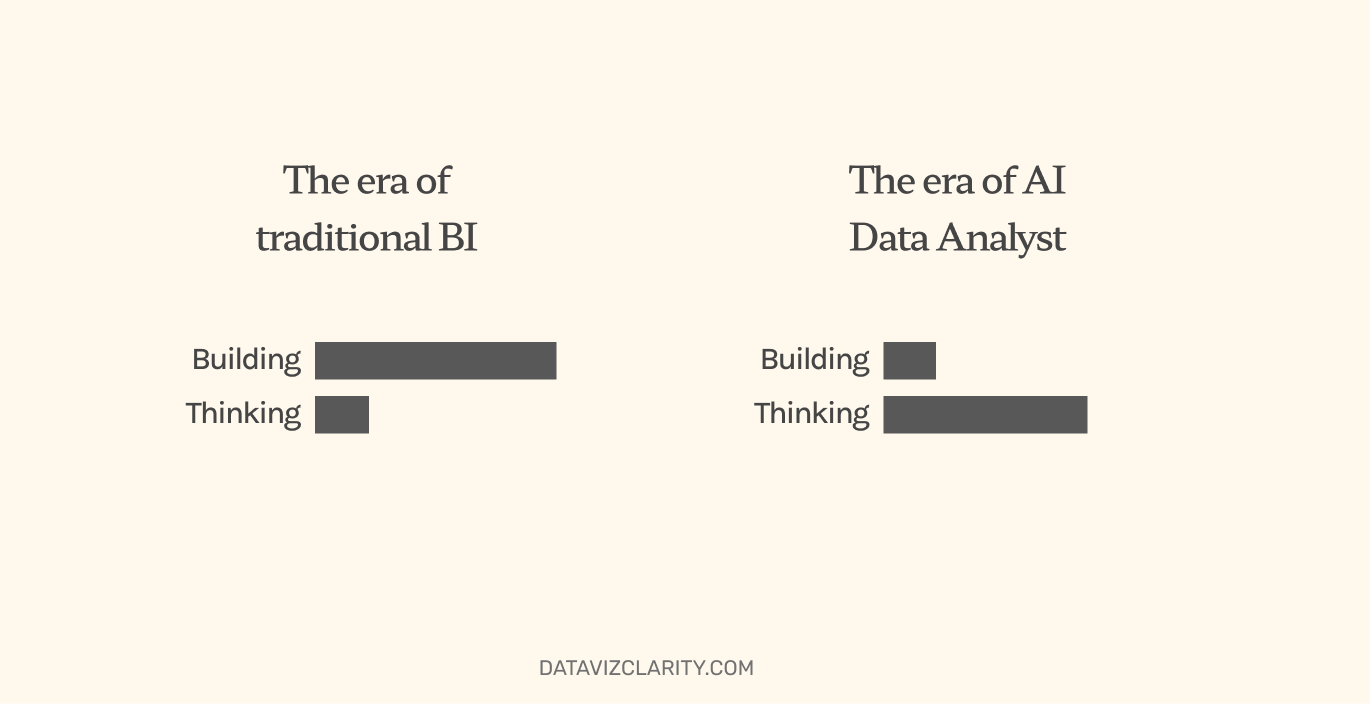
Where we previously spent considerable time building interfaces in Tableau or Power BI, positioning objects, configuring interactions, adjusting filters, or managing visual behaviors, we can now generate an initial functional version through natural language instructions.
Iteration is becoming considerably easier too. Changes in layout, new charts, additional interactions, or different ways of presenting information can sometimes be achieved with just a few prompts.
Based on what I've observed, cutting the development time of certain interfaces in half seems entirely plausible, although this still needs to be measured under comparable quality and maintenance requirements.
But building faster doesn't necessarily mean building better products.
For years, I've observed recurring problems in BI projects: teams rushing toward solutions, poorly qualified requirements, limited user research, and an approach centered on tools rather than business problems.
And what I'm seeing in early AI projects isn't particularly reassuring.
I've witnessed POCs launched very quickly, sometimes turned directly into products used by business teams, without any meaningful discovery phase.
Teams receive a request and almost immediately start developing. At best, a workshop brings six or seven people around the same table to gather requirements.
This kind of group workshop can help align stakeholders, but it doesn't replace proper user research, particularly when the objective is to understand individual behaviors and decision-making processes.
A bad BI dashboard won't suddenly become a good analytics product simply because it's now generated by AI.
It might look better, offer more interactions, and be developed much faster. But it could still be completely useless.
A shift in ownership, but who is responsible for Product and UX?
This is probably my biggest concern about this transformation.
As embedded analytics solutions become more common, responsibilities for developing interfaces could increasingly move from BI teams to digital teams and Software Engineers.
These teams generally have strong technical skills in building applications, integrating services, and leveraging AI capabilities.
But that doesn't necessarily mean they're experienced in discovery, UX Research, requirements qualification, or analytics product design.
And when products are developed without the involvement or validation of designers, UX Researchers, or experienced Product Managers (with a solid background in data analytics) fundamental questions risk going unanswered.
- Have we correctly identified the business problem?
- Does the proposed experience genuinely fit users' daily activities?
- Have design decisions been validated with the people who will actually use the product?
- And most importantly, how will we demonstrate that the product generates real value?
A dashboard or an AI agent can be technically impressive, visually polished, and fully functional without improving a single decision.
I don't believe Software Engineers are inherently less capable of understanding users than Data Analysts. In fact, Data Analysts have been making these same mistakes for years.
The issue is primarily organizational and methodological.
The real risk isn't Software Engineers taking ownership of the front end. It's transferring technical ownership without explicitly assigning Product and UX responsibilities, which too often remain a blind spot in analytics projects.
- Who ensures alignment with business objectives?
- Who validates the user experience?
- Who measures the value actually delivered?
These responsibilities need to be clearly established, regardless of which team develops the product.
For me, one of the major challenges in the coming years will be integrating Product Management, UX Design, and user research into these new development processes without sacrificing the speed benefits AI brings.
AI is already surprisingly good at applying design principles
There's another positive development I want to highlight.
Some of the first dashboards I've seen, particularly those generated with Claude Dashboards, are genuinely impressive from a visual perspective.
Layouts are often coherent, spacing is relatively well handled, and visual hierarchy is usually convincing. These tools seem to be getting increasingly good at applying fundamental data visualization principles.
Of course, their choices aren't always appropriate.
A chart can look appealing while being unsuitable for the question being asked. A comparison may lack context. A layout can be elegant without helping anyone make a decision.
But improvements are becoming easier to make. A simple prompt can reorganize a layout, replace a chart, or explore another visual representation.
For years, understanding Design Principles, data visualization guidelines, Gestalt principles, and layout best practices helped professionals create better interfaces.
Tomorrow, some of that quality could be generated automatically.
The challenge will increasingly be evaluating the result.
Knowing that a chart looks good doesn't mean it's the right chart. We still need to understand objectives, identify meaningful comparisons, and prioritize information based on the decisions the product should support.
I therefore don't believe Data Visualization Design skills will disappear. But their value will gradually shift.
We will increasingly move from applying best practices ourselves to evaluating, selecting, and improving what AI generates.
That's a significant evolution, including for experienced data visualization professionals.
Dashboards aren't dead. They'll coexist with new analytics experiences.
I don't believe dashboards are going away.
Claiming that dashboards will disappear because AI agents are emerging seems as simplistic to me as saying comic books will disappear because manga exists.
These are different formats, with different uses, strengths, and limitations.
A dashboard remains useful for monitoring indicators, comparing performance, and visually exploring a situation.
A conversational agent may be better suited to answering specific questions or guiding users through an investigation.
An automated briefing, such as the "*Insert business team name* Analytics debrief" I'm starting to see in some organizations, may be more appropriate when a manager wants a weekly summary of key developments, performance gaps, and priorities.
An alert may be enough when a specific event requires attention.
And some experiences will combine several of these capabilities.
Organizations are gaining access to a much broader range of analytics solutions. But this also makes choosing the right experience more complex.
We've spent years turning almost every business request into a dashboard. I wouldn't want us to spend the next few years turning every request into an AI agent.
Will tomorrow's Data Analyst look anything like today's?
I believe the role is going to evolve significantly, probably faster than many people expect.
First, I see some Data Analysts gradually moving away from front-end development and toward Analytics Engineering roles.
Data structuring, transformation, quality, semantic models, metric definitions, and governance remain essential. Their importance is already growing rapidly in the organizations I work with.
With the rise of AI agents, I expect this trend to accelerate.
An agent capable of generating a dashboard or producing an analysis cannot consistently compensate for inconsistent data, conflicting business definitions, or poorly designed data models.
The more we automate data consumption and analysis, the more we will depend on solid foundations.
At the same time, I expect analytics interface design and development to become increasingly shared responsibilities between digital, product, and software teams.
That doesn't mean every Data Analyst will abandon the front end. Organizations, maturity levels, and technical architectures will vary considerably.
But I'm convinced that the boundaries between BI Developers, Data Analysts, Analytics Engineers, Product Managers, and Software Engineers will evolve significantly.
I also see another transformation emerging for senior Data Analysts.
Their value will increasingly come from their ability to conduct deeper analyses, challenge hypotheses, explore scenarios, and make recommendations, using AI to support their work.
Business expertise, critical thinking, and communication skills will become even more important.
A senior Data Analyst who can understand a complex business problem, assess the reliability of an analysis, and defend a recommendation in front of an executive committee will remain highly valuable.
AI can produce analyses and suggest actions. But it doesn't independently carry organizational accountability for decisions, nor does it replace the trust built between an analyst and business leaders.
The skills Data Analysts need are changing too
To me, it's now absolutely inevitable that Data Analysts must develop their Prompt Engineering skills and broader AI literacy.
This goes beyond experimenting with a few prompts in ChatGPT or Claude. It's about understanding how these technologies work, what they're capable of, where their limitations lie, and how to integrate them effectively into analytical workflows.
Development assistants, conversational interfaces, AI agents, and embedded analytics applications will progressively transform how we work.
I believe Data Analysts who don't start developing their AI capabilities today risk falling behind professionals who can perform certain analyses much faster and explore possibilities that were previously difficult to access.
But I don't believe Prompt Engineering alone will remain a sufficiently differentiating skill in the long run.
As models improve, some prompting techniques may become less necessary.
What will remain essential is the ability to structure a problem, provide context, formulate relevant instructions, challenge results, and evaluate the reliability of an answer.
And that's why I believe Data Analysts will also need to strengthen their skills in methodology, UX, and Product Management.
Gathering and qualifying business needs, understanding users and their constraints, identifying the real problem, and defining the decisions the product needs to support should all come before choosing a technology.
These skills already existed in traditional BI. But their importance will grow as technical production accelerates.
Tomorrow's Data Analysts will need to master AI, but their value will still depend on their ability to understand business problems and turn data into meaningful decisions.
What does this mean for BI and Data Visualization experts?
This is also a question I've been asking myself.
A significant part of my work today involves supporting data teams, designing analytics products, teaching Design Principles and the Design Process, and helping BI professionals develop their skills.
I don't believe these areas of expertise are becoming obsolete. But their relative importance will change.
If AI becomes capable of generating dashboards that correctly apply readability guidelines, visual hierarchy, chart selection, and layout principles, some technical data visualization skills will probably lose part of their differentiating value.
It makes increasingly less sense to build an entire area of expertise around manually applying rules that AI can already reproduce reasonably well in many situations.
From Product UX to Analytics Portfolio UX
I also believe UX support will need to adopt a broader, more strategic perspective.
Historically, much of our attention has focused on how people read information, apply Design Principles, and interact with a specific dashboard or screen.
Going forward, we'll need to consider the entire analytics product portfolio.
How do users navigate between products? How do they move from a dashboard to a conversational agent, and then to a business application? Are these experiences consistent? Do they address complementary needs, or create unnecessary redundancy?
I find this shift toward Analytics Portfolio UX particularly interesting.
The challenge will extend beyond improving individual products to designing a coherent user experience across the organization's entire analytics ecosystem.
And in my view, UX expertise applied to data will need to become more closely connected to three dimensions: users and their actual behaviors, FinOps, and business strategy.
Why FinOps?
Because as organizations multiply analytics products, agents, and computing capabilities, questions around cost, maintenance, and actual value become increasingly important.
An analytics product can offer an excellent user experience while representing an investment disproportionate to its usage or business impact.
UX should therefore contribute to broader portfolio decisions: which products should we keep, improve, consolidate, transform, or retire?
These decisions must also reflect the company's strategy, organization, and business priorities.
This is precisely the direction I'm taking in my work today.
I'm increasingly working with clients on their Analytics Operating Model, addressing topics that go far beyond dashboards and Design Principles: analytics strategy, team organization, collaboration between business, data, and digital teams, leadership, governance, roles, and responsibilities.
The objective is to better align analytics investments, the teams building these products, and the users who expect value from them.
I'm convinced the future of UX in analytics will also be shaped at this level, where we evaluate the consistency, cost, usefulness, and business contribution of the entire analytics portfolio.
New technology, same fundamental questions
We're probably at the beginning of a major transformation in analytics.
Interface development is accelerating, the boundaries between roles are evolving, and the possibilities available to users are expanding.
I see opportunities in products more closely integrated into business processes, interfaces developed faster, and entirely new ways of interacting with data.
But I also see a familiar risk: repeating with AI the mistakes we've made for years with traditional BI.
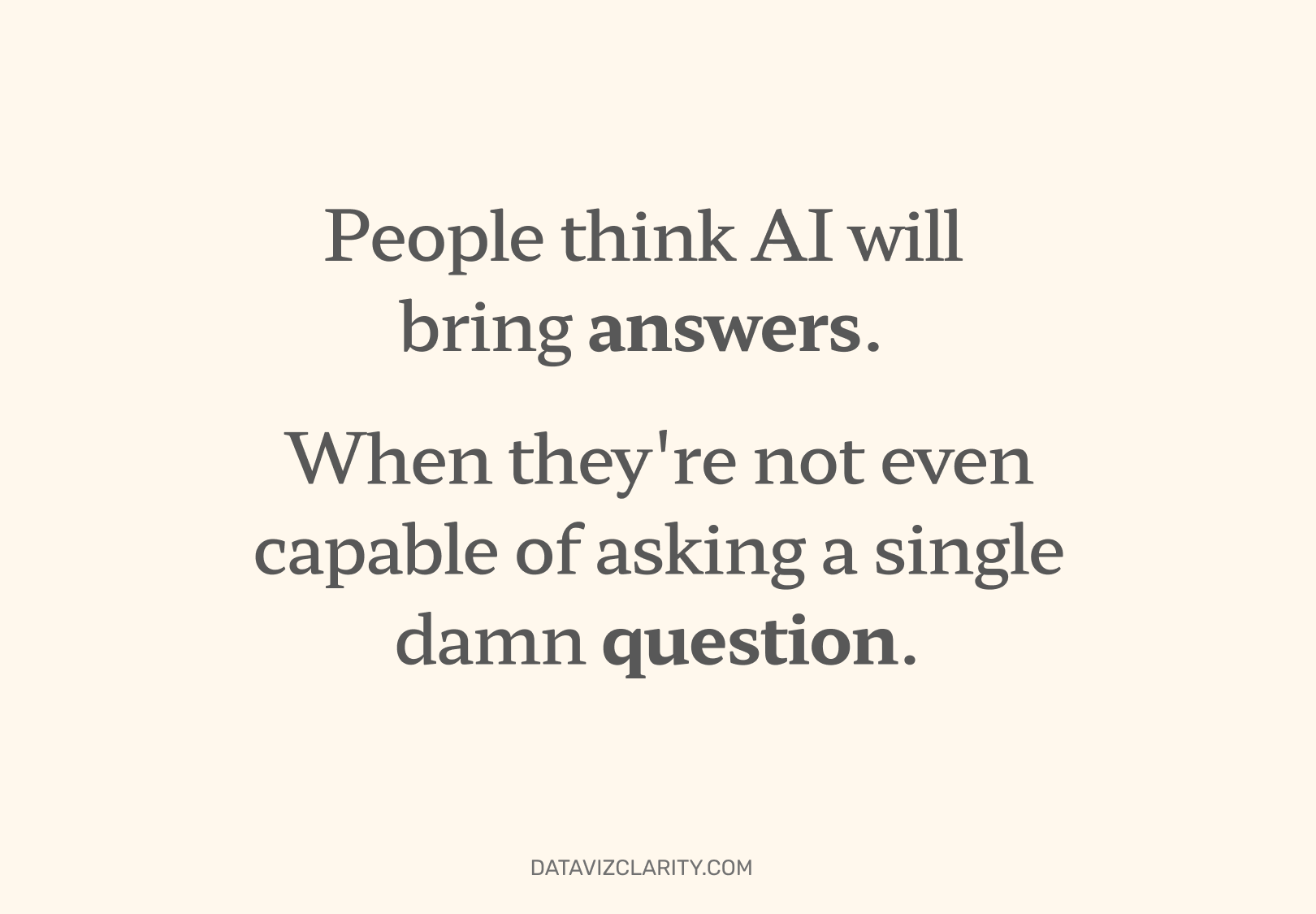
Rushing into development, neglecting user research, confusing requests with actual needs, choosing technology before understanding the problem, and building products without clearly assigned Product and UX responsibilities.
Tomorrow, we may have far fewer traditional dashboards. We'll almost certainly have more agents, embedded applications, and conversational analytics products.
But one fundamental question will remain:
Have we truly understood the problem we're trying to solve?
I believe much of the value data and analytics professionals will bring in the coming years will depend on their ability to answer that question.
And that's exactly where I want to keep developing my own expertise.
The Analytics Operating Review
A series of sharp visuals that decode common mistakes in Analytics.
We hate SPAM. We will never sell your information, for any reason.