
Hi everyone,
Today, I'm sending the latest newsletter I've ever sent in almost three years. Sorry about that!
Keeping up with a weekly newsletter, every Tuesday, during holidays, between client projects, and while building new products, requires discipline.
Sometimes it's enjoyable. Sometimes it's exhausting.
And since launching my first Analytics Design Process card deck, I've been feeling a little drained.
I've spent months creating, testing, improving, launching, and communicating about it. And now that it's out there, I'm still wondering what direction I want to take next.
But something has been on my mind lately.
AI will replace dashboards.
If you believe that, I think you're missing the bigger picture.
AI will replace many things. And improve even more.
But I'm convinced dashboards are here to stay.
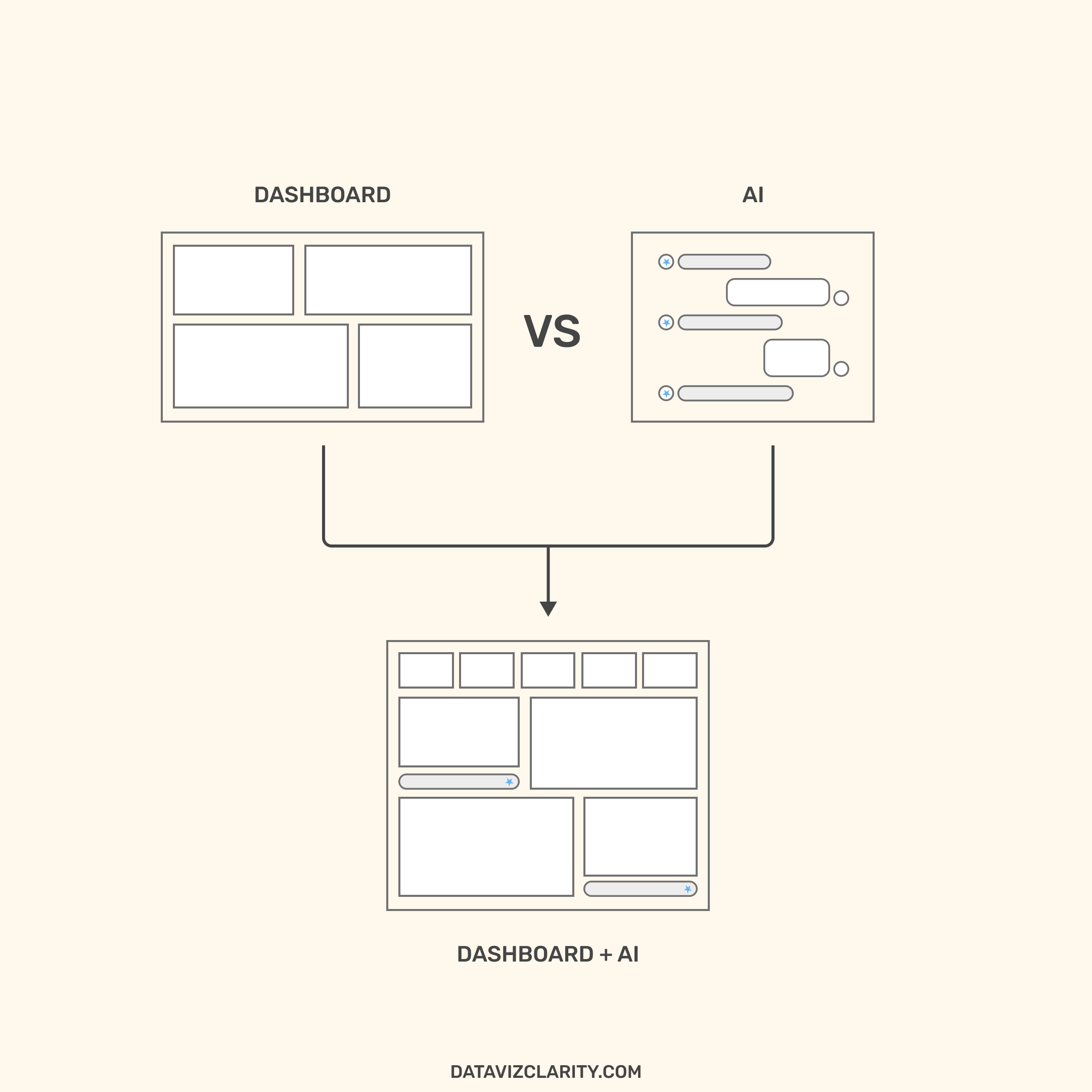
We'll need fewer dashboards. Better dashboards. And dashboards deeply integrated with AI.
We need to stop opposing tools
For 20 years, we've debated whether we should build a dashboard a report a subscription or a table.
Or whether Excel was better than any Dataviz tool.
And now we're making the same mistake again: AI vs Dashboards.
We're still opposing tools instead of questioning how people actually work and make decisions.
I believe we should be asking different questions:
-
How can we integrate AI into dashboards and analytics products and when does it actually make sense? And why should we do it in the first place?
-
What's the best user flow for our teams and business processes?
-
How can we bring analytics closer to where business decisions actually happen?
The future of analytics will be shaped by how effectively we use AI to shorten the distance between a business question and a decision.
How quickly can we deliver value? How much friction can we remove?
And why are we still making business teams wait six months for answers they need today?
What I'm seeing on the ground
I'm currently spending two days a week working with an analytics team at one of France's largest retailers, a company with more than 100K employees. (Hi guys! :) )
One of the things I enjoy most about these missions since 4 years now is being able to work closely with Data Analysts, BI Developers and Data Product Managers.
Not just talking about the future of analytics from the outside, but seeing how these roles are actually evolving.
And over the past few weeks, across several client projects, something has become increasingly clear to me.
The most interesting use of AI I've seen isn't replacing dashboards.
It's making them more useful.
Imagine opening a dashboard that doesn't just display your KPIs.
It also helps you understand what's happening, generates insights based on the data you're looking at, suggests actions, and lets you ask follow-up questions in natural language.
You see an unexpected drop in performance.
You ask why.
You explore the underlying data.
You get potential explanations, identify where to investigate, and decide what to do next.
All within the same experience.
Of course, this requires trustworthy data, appropriate safeguards, and a well-designed user experience. AI-generated recommendations are not automatically reliable.
But the potential is enormous.
And suddenly, the old debate about whether we should build a dashboard or an AI assistant starts to feel irrelevant.
We can design products that combine both.
What does this mean for our jobs?
I think this evolution will significantly change what we expect from analytics professionals.
Some development tasks will become faster, simpler, or partially automated.
And yes, I understand why some Data Analysts and BI Developers might feel threatened by that.
But look at what's becoming more important.
Someone still needs to understand the business problem.
Someone needs to identify the decisions people are trying to make and validate whether the solution is actually useful.
Someone needs to design the experience that connects dashboards, alerts, AI assistants, and business workflows.
That's why I believe Data Product Managers, Analytics Engineers, and AI Engineers have an important role to play in what comes next.
And it's also why I'm increasingly interested in Data Product Management.
Where I might be heading next
For years, I've focused on helping analytics teams design better dashboards and analytics products.
Through consulting, workshops, coaching, and more recently, my Analytics Design Process cards.
But I'm starting to think that the next chapter of my work might focus more specifically on helping Data Analysts and BI Developers develop Data Product Management skills.
Because regardless of the technology, whether you're building in Tableau, Power BI, React or using an AI-powered interface, many of the challenges remain the same.
You still need to:
-
Understand the problem before choosing a solution.
-
Interview users and stakeholders.
-
Identify business decisions and expected outcomes.
-
Prioritize requirements and manage scope.
-
Design user flows and prototypes.
-
Test assumptions before development.
-
Measure value and adoption.
-
Communicate clearly throughout the process.
These are skills I've been teaching and applying for years.
And I believe they're becoming even more relevant as the boundaries between BI, software development and AI become increasingly blurred.
I'm not announcing a new course today.
I'm still exploring the idea.
But I'm considering putting more of my energy into helping analytics professionals move beyond implementation and take greater ownership of the products they create.
A question for you
If you're a Data Analyst or BI Developer, whether you're working internally or as a freelancer, I'd love to hear from you.
Would you be interested in a practical program focused on Data Product Management, Design Thinking and analytics product design?
A program to help you move from receiving requirements and building solutions to understanding problems, challenging requests, and taking ownership of the entire product process.
If that sounds interesting, just reply to this email.
Tell me what you'd like to learn, what you're currently struggling with, or what skills you think you'll need in the next few years.
I'm genuinely curious.
And who knows? Maybe your replies will help shape what comes next.
See you next Tuesday. Hopefully on time this time!
Have a nice week!
Aurélien
There are 2 ways I can help you or your team:
- Analytics Design Process Cards: 30+ practical and visual cards featuring proven methodologies, common pitfalls, frameworks and templates to help you structure your analytics projects, understand user needs, improve collaboration, and design products that deliver real business value.
- Design Principles Virtual Training: 6+ hours of on-demand content, interactive lessons, and practical exercises to master the fundamental design principles behind clear, intuitive and impactful dashboards.
Responses