
Your dashboard is only one step in the Decision Flow
A quick update on the Analytics Card Deck and the waiting list at the bottom of this newsletter.
I've worked in Data for 12 years.
I've seen thousands of dashboards, dozens of Analytics teams, different methodologies, processes, tools and ways of working.
But there's one very simple UX method I've almost never seen Analytics teams use:
The User Flow.
And I think we're missing something important.
A decision rarely happens inside a dashboard
Think about how someone actually makes a decision at work.
- They receive an email.
- Something catches their attention.
- They open a dashboard.
- They check a KPI.
- They export some data or open another tool.
- They message a colleague.
- They discuss what they found during a meeting.
- Then, eventually, they decide what to do.
Email → Dashboard → KPI → Another tool → Conversation → Meeting → Decision → Action
The dashboard is only one touchpoint in a much larger decision journey.
Definition : A Decision Flow maps how a decision moves from its initial trigger to the final action, across information, tools, people and interactions.
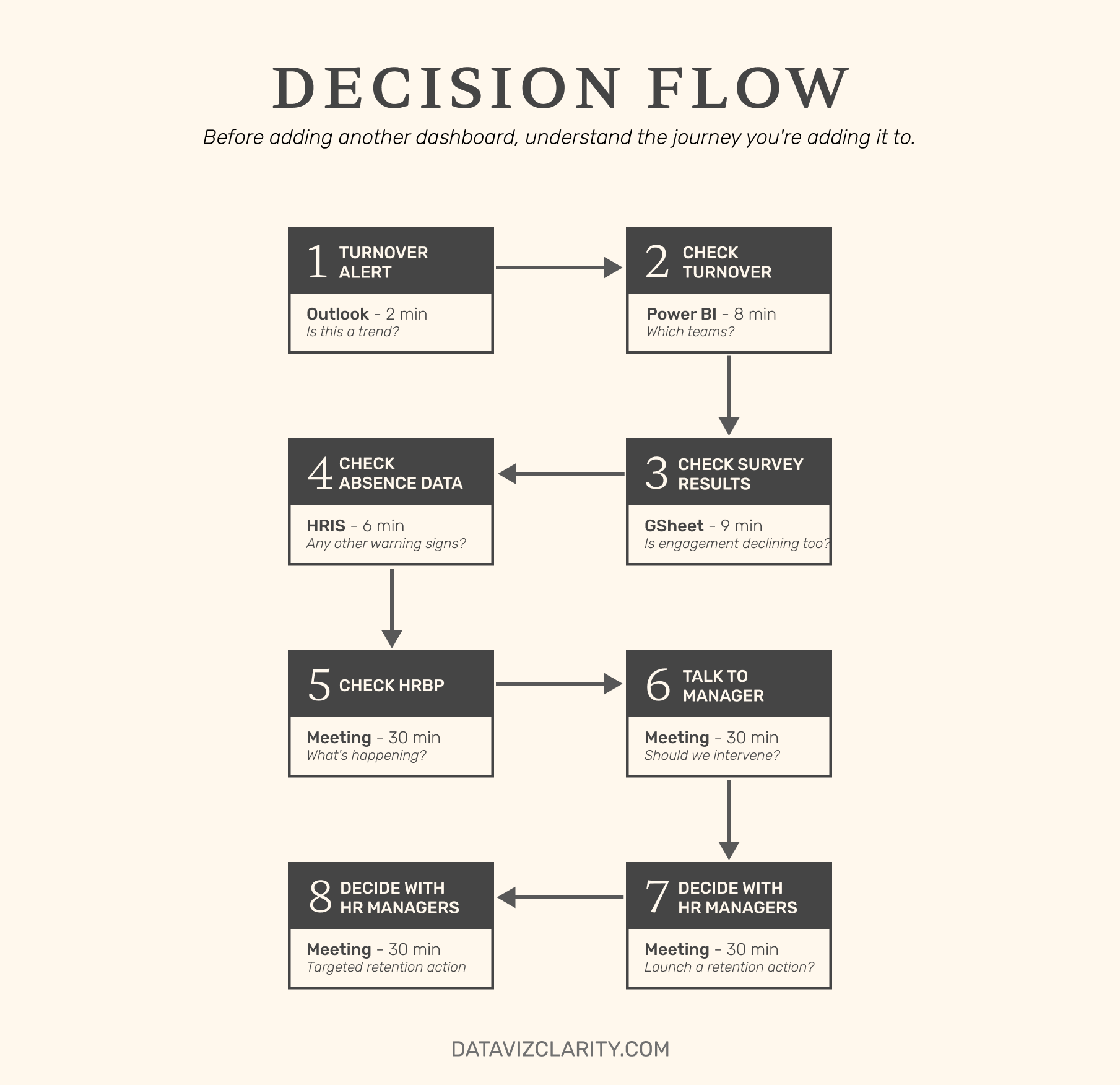
Yet when someone asks us to build a new dashboard, we tend to focus almost exclusively on that touchpoint.
- What data do you need?
- What KPIs?
- What filters?
- What pages?
- What charts?
We design the screen without necessarily understanding the journey around it.
User flow or decision flow?
DECISION FLOW
What needs to happen for the decision to be made?
USER FLOW
How does the user move through the interactions that enable it?
And that's where User Flows become incredibly useful
A User Flow maps the different steps, touchpoints and interactions someone goes through to accomplish something.
In Analytics, I find it particularly interesting to map how someone moves from: Signal → Information → Understanding → Decision → Action
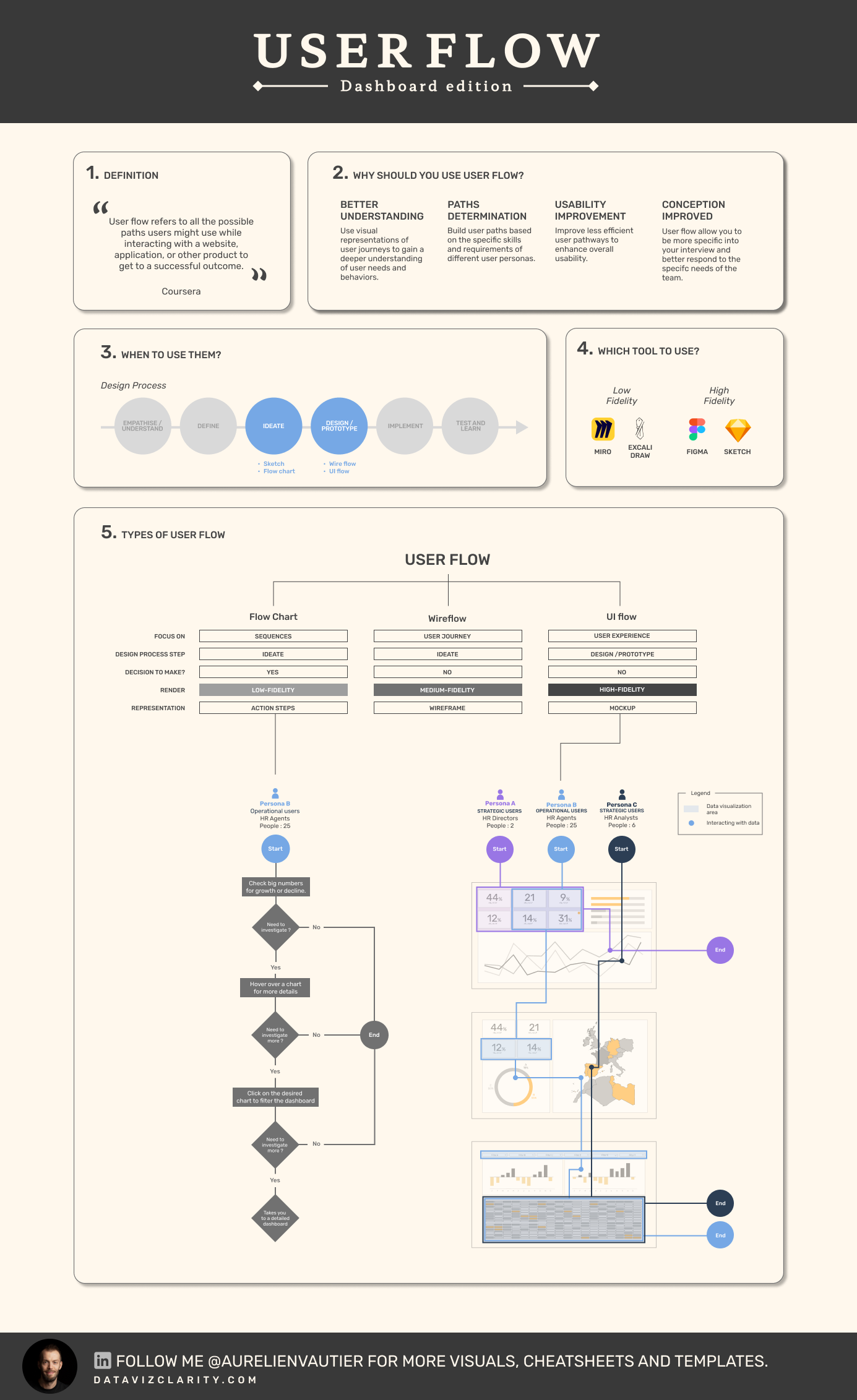
Email me back for the highest-resolution version of the visual.
- Which tools do they use?
- Who do they talk to?
- What information do they need?
- Where do they hesitate?
- Where do they leave the Analytics environment?
- What happens immediately before and after your dashboard?
Suddenly, you're thinking beyond the screen.
This can completely change what you decide to build
Imagine the current journey looks like this:
Email alert → Dashboard A → Excel → Teams message → Dashboard B → Weekly meeting → Decision
Then someone requests another dashboard.
Without understanding the existing flow, adding Dashboard C might look perfectly reasonable.
But you've potentially just added another step to an already fragmented decision journey.
- Another place to look.
- Another interface to understand.
- Another source to reconcile.
- Another transition between tools.
You can improve the dashboard while making the overall experience more complex.
Mapping the current Decision Flow gives you a completely different starting point.
You can first understand how the decision actually happens today.
Then you can design the future flow:
CURRENT FLOW (Decision flow) → FRICTIONS → FUTURE FLOW (User flow)
And only then ask:
What Analytics product should support this journey?
Sometimes the answer will be a dashboard.
Sometimes it will be an alert, a simplified view, a change to an existing product, a workflow integration, or no new product at all.
This is one of the reasons I believe Data Analysts need to borrow more from UX and Product Design
There are already methods for understanding how people navigate information, tools and interactions.
We don't need to reinvent them.
We need to start using them in Analytics.
User Flows & Decision flows are one example.
And once you start looking at Analytics products as part of a larger decision environment, designing another isolated dashboard becomes much harder to justify.
I'm also turning methods like this into my upcoming Analytics Card Deck, designed as practical tools Analytics professionals can use while working on real projects.
If you'd like to get access when they're released, you can join the waiting list here.
21 cards created: covering situations, traps, methods and templates that analytics teams can use throughout the product design process.
I'm planning to release the complete digital deck on September 23 at 9:00 AM (Paris time).
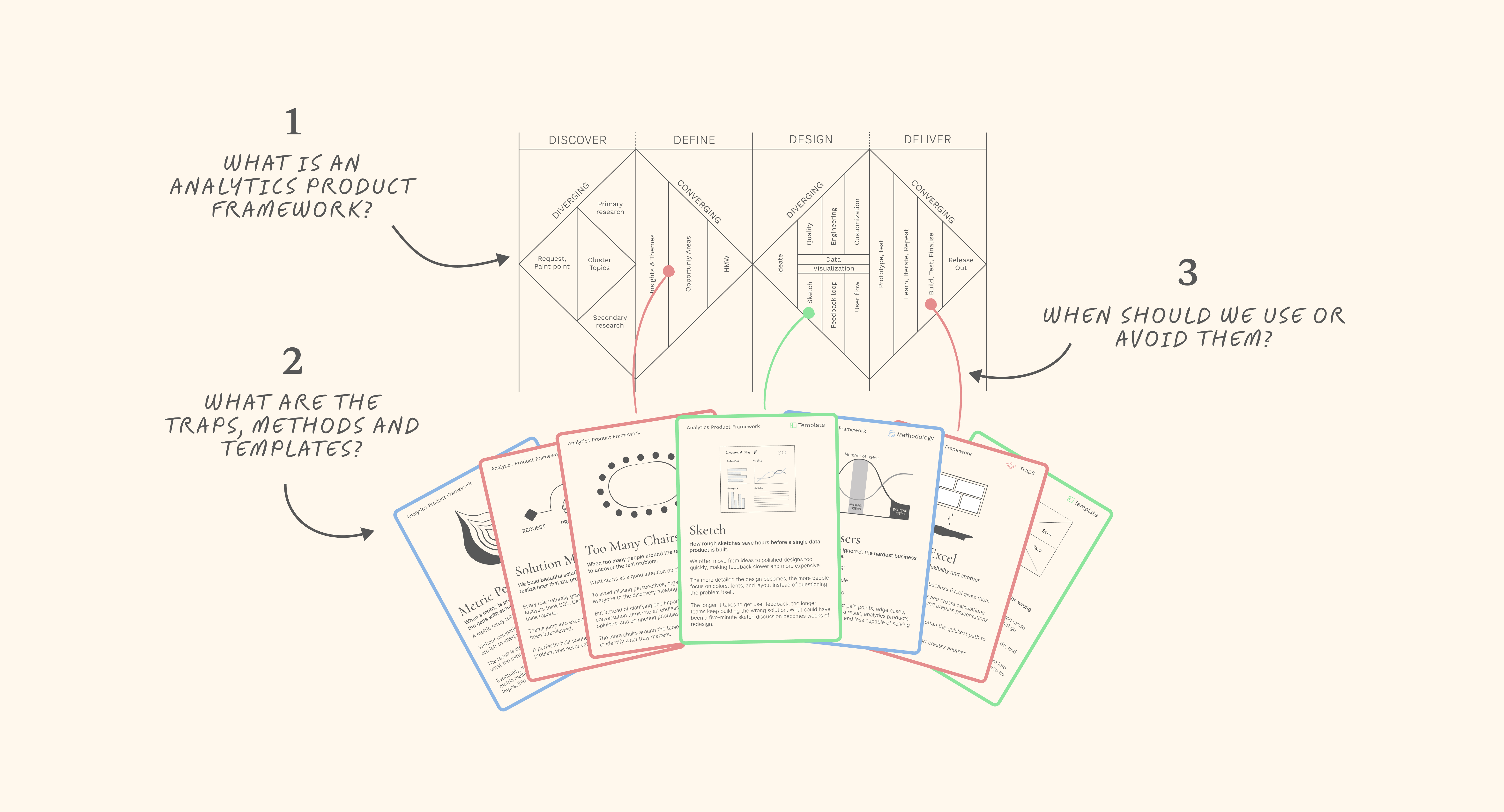
If you'd like to follow the creation of the deck, discover the next cards, and be notified when the complete digital version is released:
You can join the waiting list here.
Have a great week everyone!
Aurélien
Whenever you're ready, there are 2 ways I can help you or your team:
- Analytics Design Principles Workshop: One-day workshops to learn design principles, improve your design process, build your design system, or help business teams make better decisions with data.
- E-Learning: 6+ hours of on-demand content, interactive lessons, and practical exercises to master the fundamental design principles behind clear, intuitive, and impactful dashboards.

Responses