
What should happen between "I need this" and "Let's build it"?
Today at lunch, I pitched the Analytics Product Framework to a large luxury company in France.
I was proud to see how much the message resonated.
What we discussed is something I see regularly in Analytics teams: requests move far too quickly from an expressed need to development.
A need arrives through an email, a chat or a meeting.
Discovery exists, but often doesn't go deep enough into users' context, pain points and actual problems. The conversation quickly converges toward a solution, usually the one already mentioned in the initial request.
And very often, that solution is a dashboard.
User observations and interviews remain rare.
Mockups are sometimes skipped entirely. When they exist, they're often created directly in BI tools, leaving very little room to explore alternatives before committing to the final solution.
The pattern becomes predictable:
A user asks for a dashboard = a dashboard gets developed.
And I noticed another symptom while reviewing the existing portfolio.
Solutions systematically converge toward dashboards containing very few charts or actual data visualizations, and a lot of tables.
Naturally, users start asking:
"Can I export this to Excel?"
More tables encourage more exports. More exports reinforce Excel usage.
Progressively, the BI platform becomes an access and extraction layer rather than a place where users can understand what is happening, discover insights, make decisions and take action.
I see this as the symptom of Analytics and BI that have sometimes been adopted technically and functionally, without the methodology evolving at the same pace.
Companies invested in the platforms.
Teams learned how to build with them.
Features became available.
Thousands of products were created.
Yet the user-centered and value-oriented methodology surrounding their creation hasn't always followed.
There is often very little space between the initial request and development to investigate the problem, challenge assumptions, explore alternatives, prototype, test and determine what should actually be built.
This is where I believe Data teams need to regain authority, legitimacy and confidence.
They need enough methodology to investigate a request properly, challenge the proposed solution when necessary and recommend another one with credibility.
That's one of the ways teams can progressively move away from the dashboard factory and adopt a product methodology centered on user needs and the value generated.
And this brings me to tomorrow's card.
The Analytics Product Framework
It's the card that connects all the situations, methods, templates and traps covered throughout the deck.
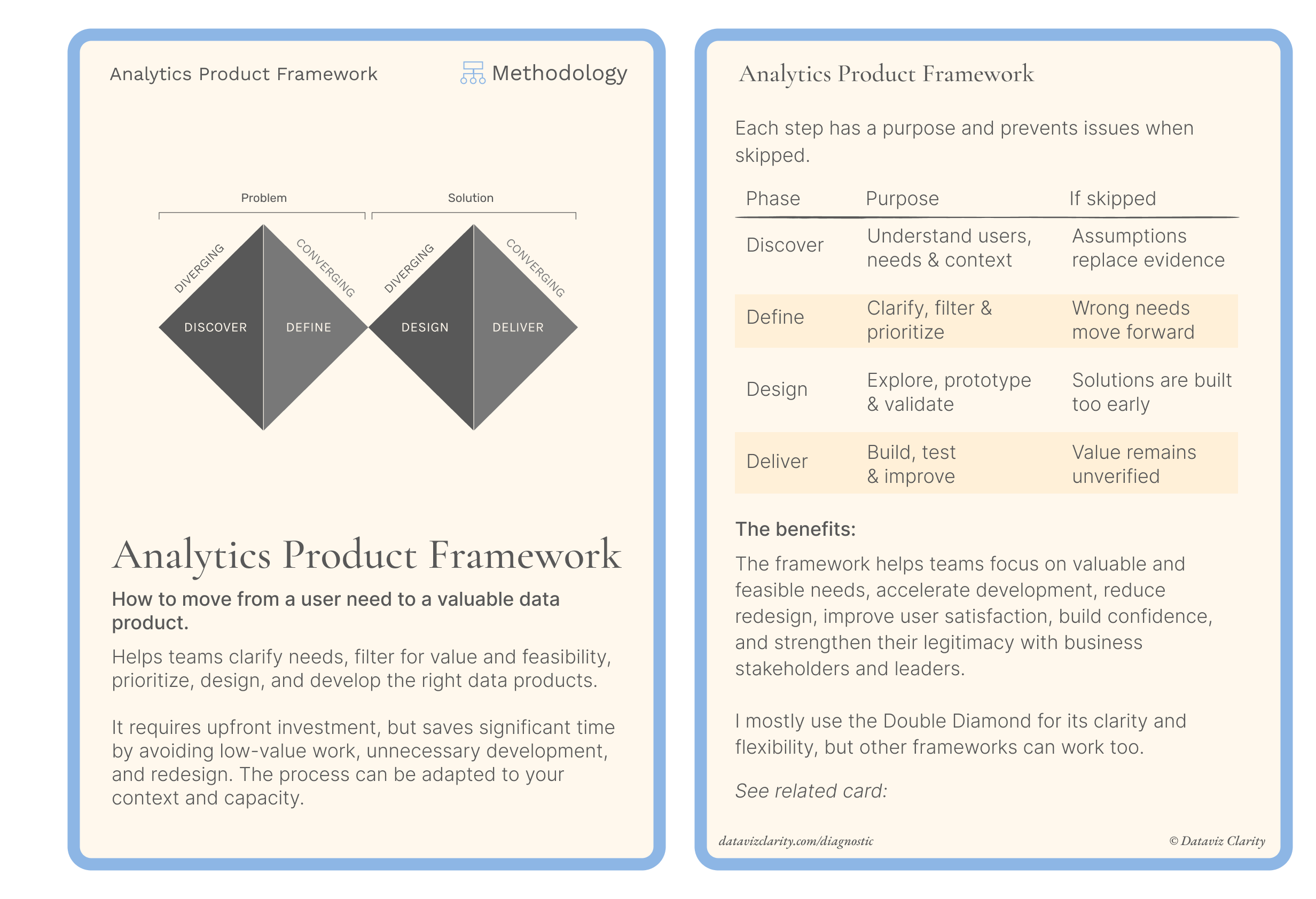
At its core:
Discover → Define → Design → Deliver
Discover the users, their context, pain points and actual needs.
Define what deserves to be solved, where the value is, what should be prioritized and what shouldn't move forward.
Design the right analytics product, explore possibilities and prototype before committing to development.
Deliver, test with users, learn and iterate.
I don't believe this framework should look exactly the same in every organization.
The stages can have different names. The process can be less linear.
Some organizations need more divergence and convergence. Others need a much lighter process.
A simple request involving ten users doesn't require the same depth as a strategic analytics product serving thousands.
The framework also depends on the volume of products already running, the number still to be produced, the size of the user base, the complexity of their needs, the maturity of the organization and the capacity of the team.
All of this has to be defined.
The framework needs to fit the reality of the organization while preserving enough methodology between "I need this" and "let's build it."
Without that space, the solution requested by the business quietly becomes the specification.
And that's how dashboard factories survive and evolve.
The Digital Analytics Card Deck
I'm currently building the complete Digital Analytics Card Deck around this framework.
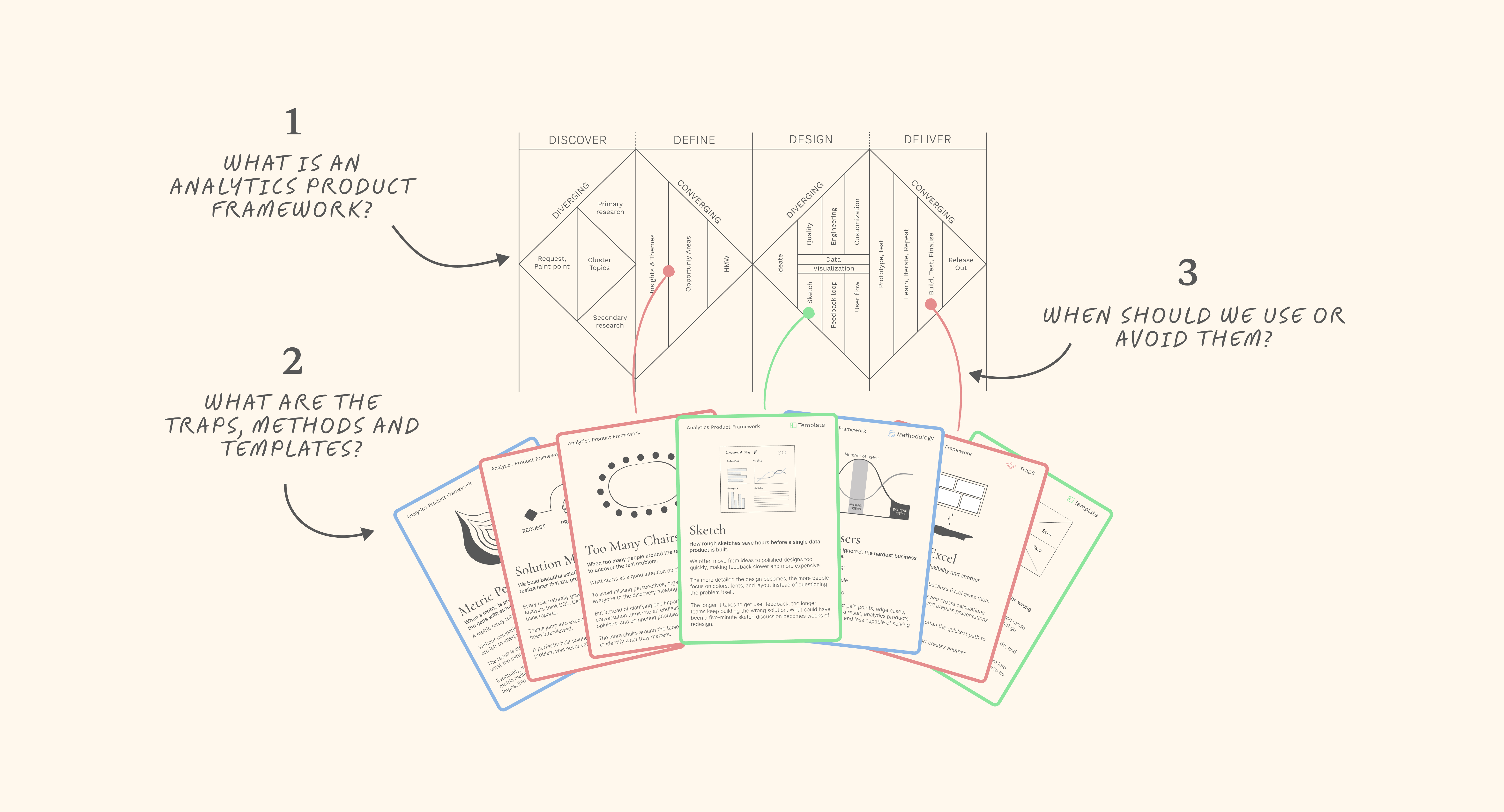
17 cards so far, covering situations, traps, methods and templates that Analytics teams can use throughout the product design process.
I'm planning to release the complete deck at the end of September.
If you'd like to follow the creation of the deck, see the next cards and get notified when the complete digital version is released :
You can join the waiting list here.
Have a great week everyone!
Aurélien
Whenever you're ready, there are four ways I can help you or your team:
- Workshop with me: One-day workshops to learn design principles, improve your design process, build your design system, or help business teams make better decisions with data.
- Analytics Product Office: Give your team a dedicated Analytics Design Office: one ticket board, one place to ask questions, fast expert responses directly from me. Get support on user interviews, workshop facilitation, product thinking, methodology, communication, and analytics product practices whenever you need it.
- E-Learning: 6+ hours of on-demand content, interactive lessons, and practical exercises to master the fundamental design principles behind clear, intuitive, and impactful dashboards

Responses